

Murphy Bed vs. Sleeper Sofa: Which Is Better for Overnight Guests?
When you need an extra place for overnight guests but don’t want to dedicate an entire bedroom to occasional visitors, two solutions usually rise to the top of the list: a Murphy bed or a sleeper sofa.
Both can turn a multipurpose room into a sleeping space. Both allow homeowners to make better use of limited square footage. And both can eliminate the need for a traditional bed that occupies valuable floor space all year.
But that’s where many of the similarities end.
A Murphy bed and a sleeper sofa approach the problem in very different ways. One hides a bed vertically against the wall when it isn’t needed. The other combines a sofa and a fold-out sleeping surface into a single piece of furniture.
So which is better?
The answer depends on how you use the room, how often you host overnight guests, how much you value sleeping comfort, and what you want the space to look like the other 350 or so nights of the year.
Let’s compare the two.
What Is the Main Difference Between a Murphy Bed and a Sleeper Sofa?
The most important difference is simple.
A Murphy bed is primarily a bed that can be stored away. A sleeper sofa is primarily a sofa that can become a bed.
That distinction affects almost everything else.
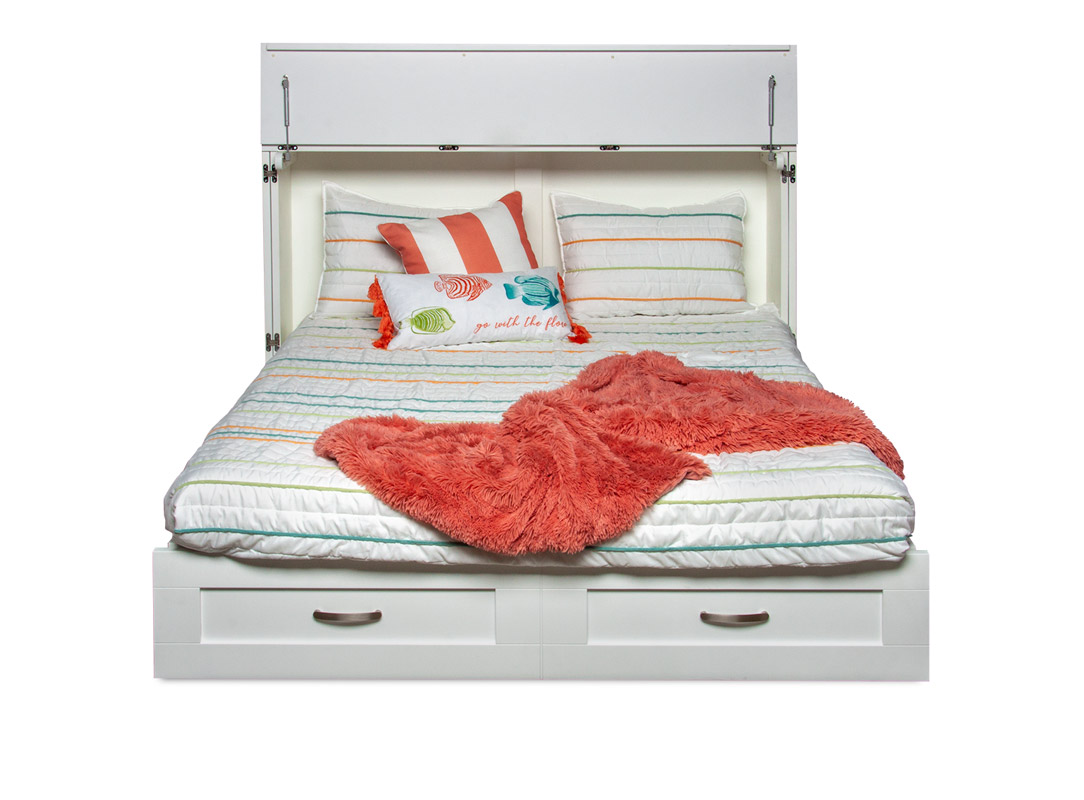
A Murphy bed is designed to provide a sleeping experience much closer to a conventional bed. When it isn’t needed, the bed folds vertically into a cabinet or wall-bed system, freeing the floor space for another purpose.
A sleeper sofa remains in the room at all times. When guests stay overnight, a mattress or sleeping surface folds out from inside the sofa.
Neither solution is automatically right for every homeowner. The better choice depends largely on what you expect from the room.
Sleeping Comfort: Murphy Bed vs. Sleeper Sofa
For many homeowners, this is the biggest consideration.
Sleeper sofas have improved considerably over the years, but their basic engineering presents a challenge. The mattress or sleeping surface has to fold into the sofa.
That requirement can limit mattress thickness and construction. Depending on the design, sleepers may also feel parts of the support mechanism beneath the mattress.
For an occasional overnight stay, that may be perfectly acceptable.
But if parents, grandparents, adult children, or other guests regularly stay for several nights at a time, sleeping comfort becomes much more important.
A Murphy bed doesn’t require the mattress to fold into a sofa mechanism. Depending on the wall-bed system and its specifications, homeowners can use a substantially more conventional mattress.
That can make the room feel like a true bedroom when the bed is open.
Your guests aren’t simply finding somewhere to sleep. They have an actual bed.
Winner for Sleeping Comfort: Murphy Bed
If your top priority is giving overnight guests an experience that resembles sleeping in a conventional bedroom, a Murphy bed generally has the advantage.
Everyday Floor Space
This is another area where the two solutions differ significantly.
A sleeper sofa saves space compared with maintaining both a sofa and a separate guest bed. But the sofa itself remains in the room every day.
That may be exactly what you want if the room is primarily a den or TV room.
But what if the room needs to serve another purpose?
Imagine a home office. You may need a large desk, comfortable office chair, filing storage, and room to move around. A full-size sofa can consume floor space that doesn’t contribute much to the room’s everyday function.
The same issue applies to an exercise room, playroom, craft room, or homeschooling space.
A Murphy bed can use vertical wall space rather than permanent floor space. When the bed is stored, much of the sleeping footprint disappears.
That can dramatically change how the room feels and functions.
Winner for Open Floor Space: Murphy Bed
For homeowners trying to maximize usable floor space during the day, a Murphy bed is difficult to beat.
Seating: Sleeper Sofa Has an Obvious Advantage
There is one category where the sleeper sofa has a clear built-in advantage.
It’s a sofa.
If you genuinely need everyday seating in the room, a sleeper sofa can perform two valuable functions with one piece of furniture.
In a den, media room, basement, or family room, that can make excellent sense. The sofa is used regularly, and the bed function becomes an added benefit.
This is why the question shouldn’t simply be, “Which takes up less space?”
The better question is:
What does the room need when nobody is sleeping in it?
If the answer is “a sofa,” then a sleeper sofa deserves serious consideration.
If the answer is “open floor space,” a Murphy bed may be the better solution.
Winner for Built-In Seating: Sleeper Sofa
If the room already needs a sofa, combining seating and occasional sleeping space can be efficient.
Which Is Better for a Home Office?
The home office is one of the strongest arguments for a Murphy bed.
A dedicated office should ideally feel like an office.
Walking around a large sofa to reach your desk isn’t necessarily the best use of the room. Neither is having a traditional bed occupying half the floor.
A Murphy bed can allow the room to remain focused on work most of the time while still providing guest accommodations when needed.
Depending on the design, a wall-bed system can also incorporate useful office features such as cabinetry, shelving, storage, or a work surface.
Instead of placing a bed or sofa into an office, the entire room can be designed as a coordinated multipurpose space.
Winner for Home Offices: Murphy Bed
Which Is Better for a Den or TV Room?
Here the answer may change.
If your multipurpose space is primarily used for watching television, reading, or relaxing, you probably need seating.
A sleeper sofa can be a logical choice because it serves an important function every day.
However, homeowners should consider how frequently the sleeping function will be used and who will be sleeping there.
A sleeper sofa might be perfectly suitable for occasional visits from younger guests. If older parents stay for a week several times a year, a more traditional sleeping surface may be preferable.
Another possibility is designing a room with a Murphy bed and separate seating. Whether that makes sense depends on the size and layout of the room.
Winner for Dens: It Depends
A sleeper sofa has the advantage when everyday seating is essential, while a Murphy bed may still win when guest comfort is the higher priority.
What About Mattress Size?
Mattress size matters more than many homeowners initially realize.
It’s easy to think, “We just need somewhere for guests to sleep.”
But two adults sharing a small or thin sleeping surface for several nights may feel very differently about the arrangement.
Murphy beds can be designed around common mattress sizes, including larger sleeping surfaces appropriate for couples, depending on the specific system and available room dimensions.
Sleeper sofa sizes vary considerably. The exterior width of the sofa doesn’t necessarily tell you exactly how large or comfortable the sleeping area will feel.
When comparing options, don’t just measure the furniture while it’s closed.
Measure the actual sleeping surface.
Don’t Forget the Space Required When the Bed Is Open
Both Murphy beds and sleeper sofas need clearance when converted for sleeping.
This is easy to overlook when shopping.
A sleeper sofa may fit beautifully against a wall during the day but extend significantly into the room when opened. Coffee tables, chairs, ottomans, or other furniture may need to be moved every time someone stays overnight.
A Murphy bed also extends into the room when lowered.
The difference is that a well-planned Murphy bed installation can be designed specifically around the dimensions and traffic patterns of the room.
Before choosing either option, think through what happens at bedtime.
Can the bed open without moving several pieces of furniture?
Can guests comfortably walk around it?
Can they access the door and closet?
Can they reach their luggage?
A multipurpose room works best when transforming it doesn’t become a nightly furniture-moving project.
Storage and Organization
A sleeper sofa gives you a sofa and sleeping accommodations, but it generally doesn’t solve the room’s broader storage needs.
A Murphy bed system can potentially do much more.
Depending on the configuration, cabinetry can provide space for linens, office supplies, books, clothing, hobby materials, or other household items.
Shelving can provide display space.
The overall installation can become part of the architecture of the room rather than simply another piece of furniture sitting in it.
For homeowners trying to create a polished multipurpose room, that integration can be a major advantage.
Winner for Integrated Storage: Murphy Bed
Appearance Matters Too
Furniture affects how we perceive a room.
Put a sleeper sofa into a home office and the room may begin to feel like a combination office and den.
Put a conventional bed in the same room and it will probably feel like a bedroom with a desk.
A Murphy bed offers another possibility.
When closed, a thoughtfully designed wall-bed system can resemble cabinetry or built-in furniture. The sleeping function becomes visually secondary until it is needed.
That allows the room’s primary identity to remain intact.
An office still looks like an office.
A craft room still looks like a craft room.
A library can still feel like a library.
Then, when guests arrive, the room becomes a bedroom.
That visual flexibility is one of the reasons Murphy beds work so well in homes where every room needs to serve more than one purpose.
What About Cost?
Price is one area where comparisons can become misleading.
Both sleeper sofas and Murphy beds are available across a wide range of price points. A basic sleeper sofa is very different from a premium upholstered model, just as an inexpensive wall-bed product is very different from a professionally designed Murphy bed system with custom cabinetry.
Rather than comparing only the initial purchase price, consider what you’re actually buying.
Will you need additional storage furniture?
Do you still need a desk?
Will you need shelving?
How long do you expect to use the furniture?
How important is the guest sleeping experience?
And perhaps most importantly, how much value does reclaiming the room’s floor space provide to your family?
The cheapest sleeping solution isn’t necessarily the best use of an entire room.
Consider Who Your Guests Are
Your typical overnight guest should play a major role in the decision.
If the sleeping space is mostly for children’s sleepovers or an occasional overnight visitor, a sleeper sofa may be completely adequate.
If your parents visit for a week at Thanksgiving, comfort may deserve greater consideration.
If adult children return home periodically, having a genuine bed available can make longer stays much more comfortable.
And if guests visit frequently, the difference between “somewhere to sleep” and “a comfortable guest room” becomes increasingly important.
Hospitality doesn’t require maintaining an empty bedroom year-round.
But when guests do arrive, providing a comfortable place to sleep can make their visit better for everyone.
Think About the Other 350 Nights
When comparing a Murphy bed with a sleeper sofa, homeowners naturally focus on what happens when guests arrive.
It’s equally important to think about what happens when they leave.
What will this room do during the rest of the year?
If you want a den with a comfortable couch, a sleeper sofa may be exactly what you need.
But if you want an office, exercise room, playroom, craft space, study area, or another room where open floor space matters, permanently devoting part of the room to a sofa may not solve the underlying problem.
A Murphy bed allows the guest function to largely disappear when it isn’t needed.
And for many households, that’s the real advantage.
Murphy Bed or Sleeper Sofa: Which Should You Choose?
There isn’t one correct answer for every home.
A sleeper sofa may be the better choice if:
- You need everyday seating in the room.
- Overnight guests are relatively infrequent.
- The room primarily functions as a den or TV room.
- Maximizing completely open floor space isn’t a major priority.
A Murphy bed may be the better choice if:
- Guest sleeping comfort is important.
- You regularly host couples, parents, grandparents, or adult children.
- You want the room to function primarily as an office, gym, playroom, hobby room, or study.
- You want to reclaim as much floor space as possible when guests aren’t there.
- You want the option of integrating cabinetry, shelving, storage, or other features into the room.
- You prefer a multipurpose space that doesn’t look like a bedroom when the bed isn’t being used.
The Best Guest Room May Not Look Like a Guest Room
A dedicated guest bedroom sounds wonderful—until you consider how often it actually gets used.
For many households, preserving an entire room for occasional visitors no longer makes sense. Families need offices. Kids need places to study and play. Adults want room for exercise, hobbies, and projects. Homes need to work harder than they once did.
Both sleeper sofas and Murphy beds can help a room serve more than one purpose.
But they solve the problem differently.
A sleeper sofa asks the room to accommodate a sofa every day so that it can occasionally become a bed.
A Murphy bed allows the bed itself to disappear from the floor plan when it isn’t needed.
If your room needs seating every day, the sleeper sofa may be the natural choice. But if your goal is to create a comfortable sleeping space for guests without sacrificing the room the rest of the year, a Murphy bed offers a compelling combination of comfort, flexibility, and efficient use of space.
The best choice isn’t simply about where your guests will sleep.
It’s about how you want to live in the room after they go home.