

More House Without More Square Footage: Making Every Room Work Harder
For years, the conventional solution to needing more space was simple: buy a bigger house. Need a home office? Add another bedroom. Want a dedicated guest room? Look for a four-bedroom instead of a three-bedroom. Need space for exercise equipment, hobbies, or the kids? More square footage seemed like the obvious answer.
But more homeowners are discovering a different approach: instead of adding more space, make the space you already have work harder.
A room doesn’t necessarily need to have one purpose. A home office can become a comfortable guest room when family visits. A playroom can provide overnight accommodations for grandparents. A bonus room can serve as an exercise space most of the year and transform into a bedroom when needed.
The key is designing the room around how you actually live.
A well-designed Murphy bed makes that transformation possible. Instead of allowing a traditional bed to dominate a room that is only occasionally used for sleeping, a Murphy bed lets homeowners reclaim valuable floor space while still having a comfortable bed available whenever it is needed.
The Problem With the Traditional “One Room, One Purpose” House
Traditional home design tends to assign every room a permanent identity.
This is the kitchen. This is the dining room. This is the office. This is the guest bedroom.
That works well when every room is used regularly. But many homes contain spaces that spend much of their time waiting for someone to use them.
The guest room is one of the best examples.
Imagine having overnight guests for 20 nights during an entire year. That’s plenty of visiting family and friends. But it also means the room may sit largely unused for the other 345 nights.
Meanwhile, someone is working at the dining room table because there isn’t a dedicated office.
The kids are doing homework at the kitchen counter.
Exercise equipment is squeezed into the primary bedroom.
Craft supplies are stored in closets because there isn’t anywhere to actually work on projects.
The house may technically have enough square footage. The problem is that the square footage isn’t being used efficiently.
That’s where multipurpose design changes the equation.
Think in Terms of Functions, Not Rooms
One of the most useful ways to rethink a home’s layout is to stop asking, “What is this room?”
Instead ask:
“What do we need this room to do?”
The answers may include several functions.
A spare bedroom might need to provide a quiet place to work Monday through Friday, space for a teenager to study in the evenings, and a comfortable place for grandparents to sleep several times a year.
Those uses aren’t incompatible.
They simply require furniture that can adapt.
A conventional queen bed occupies roughly 33 square feet before accounting for the space needed to walk around it. Add nightstands and other bedroom furniture, and much of a typical spare room can become permanently dedicated to sleeping.
A Murphy bed changes the relationship between the bed and the room. When sleeping accommodations aren’t needed, the bed can be stored vertically, opening the floor for whatever happens during the rest of the day.
Suddenly, the question isn’t whether you have enough rooms.
It’s how many functions each room can comfortably perform.
Turn the Guest Room Into a Real Home Office
Remote and hybrid work have permanently changed what many families expect from their homes.
A laptop at the kitchen table may work occasionally. It becomes much less appealing when you’re working from home several days a week.
A dedicated office provides privacy, organization, better ergonomics, and a psychological separation between work and home life.
Unfortunately, the logical location for that office is often the guest bedroom.
Many homeowners hesitate because they don’t want to lose the ability to host family and friends.
You don’t necessarily have to choose.
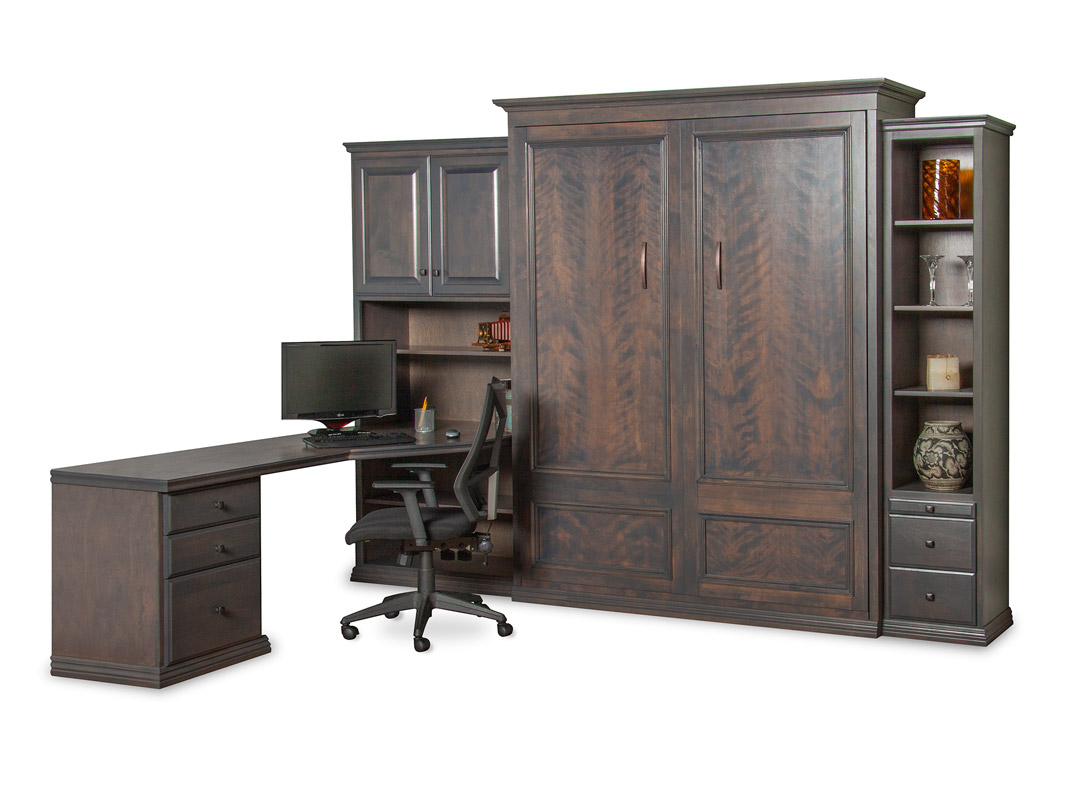
A Murphy bed allows the room to operate primarily as an office while maintaining its secondary role as a guest bedroom.
During an ordinary workday, the bed is stored away and the room feels like an office—not a bedroom where someone happened to put a desk.
When guests arrive, the bed comes down and the space transforms.
Depending on the Murphy bed configuration, cabinetry, shelving, storage, and workspace can also be incorporated into the overall design. Instead of assembling a collection of unrelated furniture, homeowners can create a cohesive room designed around both purposes.
Give Kids More Room to Grow
Children’s needs change surprisingly quickly.
A playroom filled with toys eventually becomes a homework room. Later, it may become a gaming room, music space, teen hangout, or place for friends to spend the night.
A flexible room can evolve with them.
This is particularly valuable for families who don’t want to move simply because their children are getting older and using the house differently.
A Murphy bed can provide sleeping space when needed without requiring a permanent bed in the middle of the room. That leaves more open space for younger children to play and gives teenagers room for desks, seating, hobbies, and friends.
When grandparents or other relatives visit, the same room can become a comfortable guest bedroom.
The room changes because the family changes.
That’s exactly what good home design should allow.
Create an Exercise Room You Will Actually Use
Home exercise spaces often lose the battle for square footage.
A treadmill ends up in a bedroom. Yoga happens between the coffee table and sofa. Weights migrate into the garage.
A rarely used guest room might seem like the obvious alternative, except for one problem: the bed occupies most of the usable floor.
A Murphy bed can free that space.
With the bed stored, the room can accommodate yoga mats, free weights, stretching, a stationary bike, or other equipment. When guests arrive, movable equipment can be relocated and the bed lowered.
Instead of maintaining a bedroom that occasionally gets used, you’re creating a room that provides value every week.
And that distinction matters.
Make Space for Hobbies Without Taking Over the House
Adults need space for their interests too.
Sewing, painting, model building, music, photography, collecting, crafting, and countless other hobbies require surfaces and storage. Without a designated area, projects tend to spread into dining rooms, kitchens, garages, and closets.
A multipurpose room can provide dedicated hobby space without eliminating guest accommodations.
Built-in cabinetry can help keep supplies organized. Shelving can display collections or finished projects. A worktable can become the room’s primary feature rather than squeezing everything around a permanent bed.
When visitors arrive, the room can still perform its occasional bedroom duties.
This is one of the biggest advantages of thinking differently about square footage: the people who live in the house every day get priority over the people who sleep there occasionally.
Guests remain comfortable, but the room isn’t preserved like a museum exhibit waiting for their next visit.
A Murphy Bed Doesn’t Have to Look Like a Compromise
Some homeowners still picture Murphy beds as purely utilitarian furniture: a mattress hidden behind a plain panel.
Modern Murphy bed designs can be very different.
A professionally designed wall bed can become an architectural feature of the room, incorporating cabinetry, shelving, storage, lighting, work surfaces, or decorative elements that complement the home’s interior.
When the bed is closed, visitors may not immediately realize there is a bed in the room at all.
That’s important because multipurpose shouldn’t mean makeshift.
The goal isn’t to cram several unrelated activities into one room. The goal is to design one attractive space that performs several functions exceptionally well.
Murphy Bed vs. Adding More Square Footage
When homeowners feel cramped, remodeling or adding onto the house may seem like the next logical step.
Sometimes it is.
But construction is expensive, disruptive, and not always possible. Lot size, zoning requirements, HOA restrictions, structural limitations, and budget can all complicate an addition.
Even when expansion is possible, homeowners should first ask whether they truly need more square footage.
Sometimes they simply need better access to the square footage they already own.
If a traditional bed occupies a room 24 hours a day but is only slept in a few weeks each year, changing that one piece of furniture can dramatically alter how the room functions.
You’re not physically making the house larger.
You’re increasing the amount of space available for everyday life.
Multipurpose Rooms Can Make Smaller Homes Feel Larger
There’s a major difference between square footage and usable square footage.
A poorly arranged 2,500-square-foot home can feel surprisingly cramped. A thoughtfully designed smaller home can feel spacious because rooms aren’t overloaded with furniture and every area has a clear purpose.
Open floor space plays a major role in that perception.
When a bed can disappear from the room, sightlines improve and movement becomes easier. The room can feel dramatically larger even though its dimensions haven’t changed by an inch.
That flexibility also gives homeowners more control over clutter. Built-in cabinetry and storage can reduce the number of freestanding pieces of furniture needed in the room.
The result can be a cleaner, calmer, more intentional space.
Design Around the 90 Percent, Not the 10 Percent
One of the best principles for designing a multipurpose room is simple:
Design primarily for how you use the room most of the time.
If you work from home 200 days a year and host overnight guests 15 days a year, the room should function beautifully as an office first.
If your children use the room every afternoon but grandparents visit four times a year, design it primarily around the children’s needs.
If you exercise five mornings a week and have holiday guests twice a year, make it an exercise room that can become a bedroom—not a bedroom where you occasionally try to exercise.
This doesn’t mean guests are an afterthought. A quality Murphy bed can provide a genuine mattress and comfortable sleeping accommodations.
It simply means the room’s everyday function shouldn’t be sacrificed for an occasional one.
Your Home Should Change With You
One of the challenges of homeownership is that life rarely remains the same for very long.
Children grow.
Work arrangements change.
Parents and grandparents visit.
Adult children come home.
Hobbies evolve.
Families need study areas, offices, exercise rooms, playrooms, guest rooms, and places to simply close the door and have some privacy.
Moving every time those needs change isn’t practical.
Flexible furniture allows the house to adapt instead.
A room that serves as an office today could become a nursery, hobby room, homeschooling space, exercise room, or study area several years from now. The Murphy bed can remain part of that changing environment, continuing to provide sleeping accommodations without dictating the room’s primary purpose.
Get More From the Home You Already Have
More space doesn’t always require a larger house.
Sometimes it requires looking differently at the rooms you already own.
That spare bedroom may actually be your future office.
The rarely used guest room may be the exercise room you’ve been wishing you had.
The bonus room may be able to serve your children every day while still welcoming grandparents during the holidays.
A thoughtfully designed Murphy bed makes those combinations possible by allowing one of the largest pieces of furniture in a home—the bed—to be available when needed and out of the way when it isn’t.
Instead of asking whether your house has enough rooms, ask a better question:
Are your rooms doing enough for you?
With thoughtful planning and the right Murphy bed design, you may discover that your home has considerably more usable space than you thought.